🌳 Pruning Birch Trees in Minnesota — Let’s Get the Timing Right
Birch trees are graceful, beautiful, and just a little dramatic when it comes to pruning. If you’ve ever cut one in late winter, you know what we mean. The sap flows. And flows. And flows.
Here’s what University of Minnesota Extension best practices tell us.
First, that sap bleeding in late winter or very early spring? It looks alarming, but it rarely harms a healthy tree. Birch trees build internal pressure during freeze and thaw cycles, and when you cut them, the sap runs. It’s mostly cosmetic.
So when should you prune?
You’ve got a few solid options in Minnesota:
✔ Late winter while the tree is dormant
This is a standard pruning window for many trees. Insects are inactive, structure is easy to see, and wounds begin sealing as growth starts. Expect sap flow, but don’t panic.
✔ Late summer into early fall
This is an excellent time for birch. Sap bleeding is minimal, and bronze birch borer activity has tapered off. Cuts seal efficiently before winter.
⚠ Late spring to early summer – this is not the best time to prune due to active birch borer. After leaf out, sap flow is reduced, which sounds great. However, this overlaps with peak bronze birch borer activity, especially May through early July. If your tree is stressed, this is not the ideal window for heavy pruning.
Now let’s talk about structure.
The most important pruning you’ll ever do on a birch happens in its first several years. Focus on:
• Removing rubbing or crossing branches
• Maintaining good spacing
• Preserving strong branch attachments
• Making small cuts while branches are still manageable
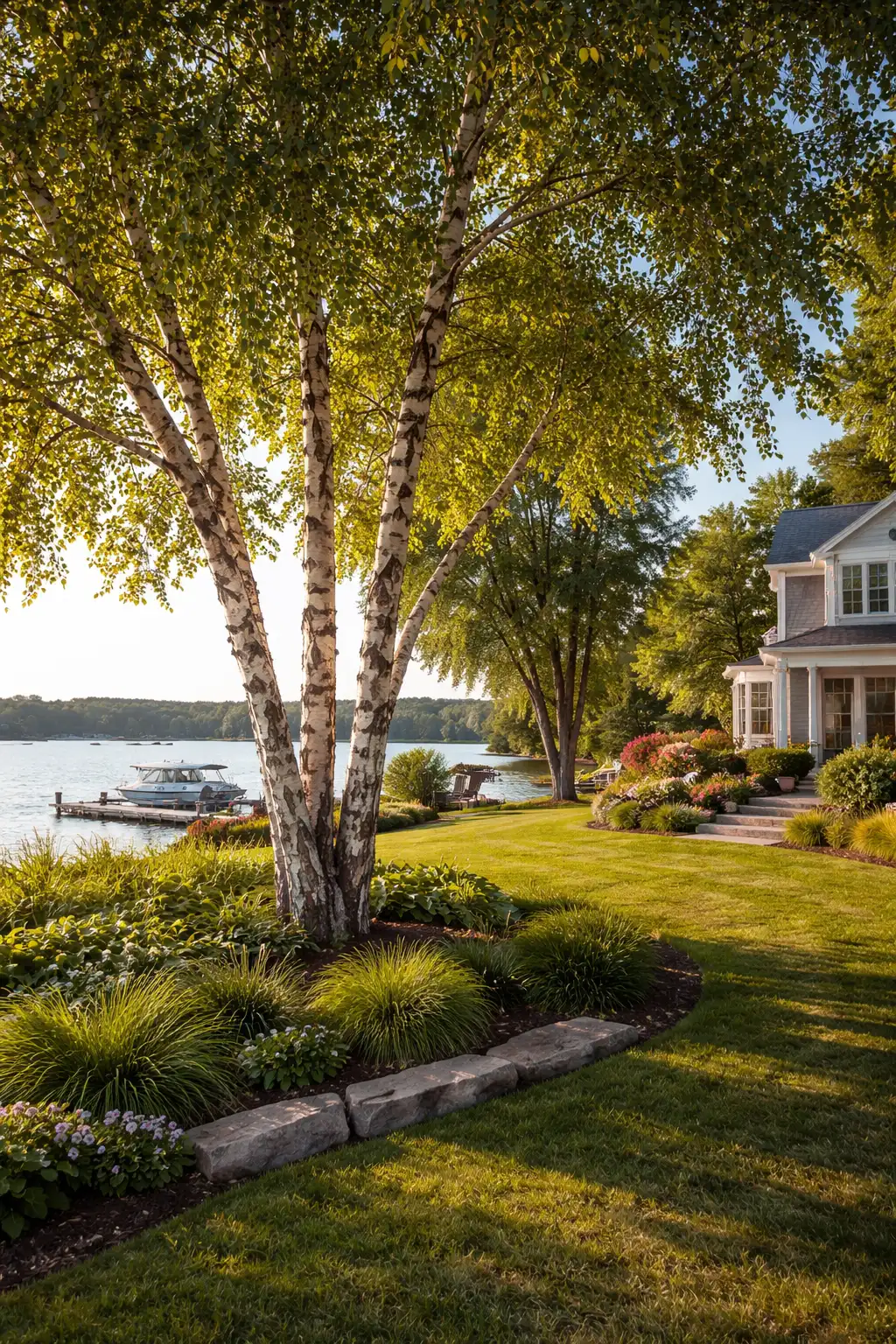
Many river birches are sold in clumps. That’s normal. Treat each stem as a leader and thin lightly to prevent crowding. A slight lean among stems is not automatically a problem.
And please — no stub cuts. No flush cuts. Always prune just outside the branch collar
so the tree can properly compartmentalize the wound.
What is a stub cut?
A stub cut happens when you remove a branch but leave a long piece of it sticking out. Instead of cutting near the trunk, you leave a little “peg” or stick.
Why this is a problem:
• The stub cannot seal over properly
• The remaining wood dies back
• Decay organisms can move inward
• The tree has to spend extra energy walling off dead tissue
In short, the tree cannot close over a stub efficiently.
What is a flush cut?
A flush cut is the opposite mistake.
This is when someone cuts the branch off completely flat against the trunk, shaving it tight and smooth.
It might look neat.
But here’s the issue:
Right where a branch meets the trunk, there is a slightly swollen area called the branch collar. That collar contains specialized protective tissue.
When you cut flush, you remove that collar.
Without it:
• The tree loses its natural defense zone
• Wound sealing is slower
• Internal decay is more likely
What is the branch collar?
The branch collar is the slightly raised or wrinkled ring where the branch joins the trunk or a larger limb.
It may look like:
• A small swelling
• A subtle ridge
• A wrinkled ring of bark
It’s not decorative. It’s biological armor.
What does “prune just outside the branch collar” mean?
It means:
• Do not leave a long stub
• Do not cut flat against the trunk
• Make your cut just beyond the collar, preserving that slight swelling
Visually, you should still see the collar intact after your cut.
What does “compartmentalize the wound” mean?
Trees do not heal like we do.
They do not replace damaged tissue.
Instead, they seal off injured areas internally. This is called compartmentalization.
When you cut correctly:
• The tree walls off decay
• New tissue gradually grows around the wound
• The cut closes over time
When you cut incorrectly:
• Decay spreads more easily
• Closure is delayed
• Structural integrity can weaken
The Simple Takeaway
Think of it like this:
A stub cut leaves a rotting stick.
A flush cut removes the tree’s natural shield.
A proper collar cut gives the tree the best chance to seal itself off cleanly.
Finally
You don’t have to fear dormant pruning. Sap bleeding is mostly visual drama. But if you want to minimize insect risk and mess, late summer is a very safe and effective window.
Prune early in a tree’s life. Prune with intention. And let your birch do what it does best — light up the landscape year round.